guides
Accident-Only vs Accident and Illness Pet Insurance: What Each Covers
What accident-only pet insurance covers, what accident and illness adds, and how far apart the prices are. Based on NAPHIA 2025 data and real policy terms, with no marketing spin.
Accident-only pet insurance pays vet bills for sudden injuries, such as a swallowed toy, a car accident, poisoning or a deep cut. Accident and illness insurance pays for those injuries too, and also for illnesses such as cancer, infections and digestive problems. Accident-only costs much less: in 2025 the average U.S. dog policy cost $190 a year, against $836 for accident and illness (NAPHIA). The real question is what that lower price leaves out.
This guide compares the two plan types using industry data, a model law and the published terms of three insurers that sell accident-only plans: Embrace, Pets Best and ASPCA Pet Health Insurance. We use them as examples, not as recommendations.
No affiliate payment influenced this guide. Every number below is linked to its primary source. If you spot an error, email us and we will publish a correction.
Quick answer: accident-only vs accident and illness
| What the vet bill is for | Accident-only | Accident & illness |
|---|---|---|
| Injuries from accidents (cuts, broken bones, swallowed objects, poisoning) | Yes | Yes |
| Illnesses (cancer, infections, digestive problems) | No | Yes |
| Cruciate ligament tear or IVDD | No at Embrace and in the Pets Best sample policy | Depends on policy |
| Pre-existing conditions | Usually not | Usually not |
| Routine care and vaccines | No, unless you add a wellness option | No, unless you add a wellness option |
| Average yearly premium in 2025 (dogs / cats) | $190 / $112 | $836 / $435 |
The premiums are NAPHIA's 2025 averages for U.S. policies in force. They are averages, not quotes. Your own price depends on your pet and where you live.
A few terms come up again and again. The premium is what you pay for the policy, by month or by year. The deductible is the part of the vet bill you pay yourself each year before the insurer pays anything. The reimbursement rate is the share of an eligible bill that the insurer pays back, for example 90%. Policies apply the deductible and this rate in a different order. Embrace's accident-only terms take off the deductible first and then apply the rate (Embrace policy terms). The Pets Best sample policy applies the rate (it calls this co-insurance) first and then the deductible (Pets Best sample policy). The annual limit is the most the insurer will pay in one policy year.
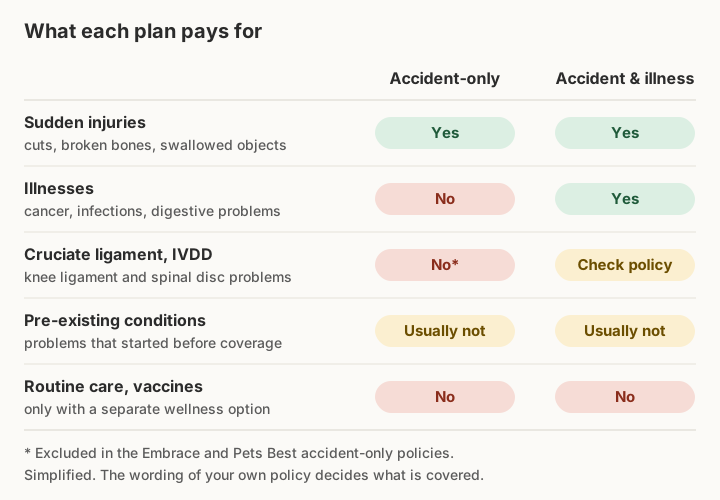 Diagram by Zero To Insurance. Simplified; your policy wording decides. Sources: NAPHIA SOI 2026, Embrace and Pets Best accident-only terms, Pets Best coverage page.
What counts as an "accident" in pet insurance?
Insurers use a narrow meaning of the word. ASPCA Pet Health Insurance calls an accident "a sudden, unpreventable event that causes physical injury to your pet" (ASPCA). Its examples include car accidents, falls, snake bites, stepping on glass, and eating grapes, chocolate or an entire tennis ball.
The Pets Best sample policy uses more formal wording. An accidental injury must come from "an unforeseen cause beyond the control of the policyholder" and must be "capable of being assigned to a particular date" (Pets Best sample policy). In plain words: you should be able to say what happened and on which day.
Typical accidents that these insurers list as covered:
- Swallowing a toy or other object (insurers call this foreign body ingestion)
- Being hit by a car
- Poisoning, including eating something toxic
- Cuts, bite wounds and torn nails
- Broken bones
- Snake bites and insect stings
- Eye injuries
- Bloat, which Embrace lists as an accident (Embrace)
Each item appears on the accident-only page of Embrace, Pets Best or ASPCA.
What does not count is just as important. The Pets Best sample policy says infectious disease, parasites, metabolic disorders, cancer, behavioral conditions and degenerative disease "will not qualify as an accidental Injury." Embrace's plan excludes illness, genetic and breed-specific conditions, conditions present from birth, chronic conditions, cancer and dental illness. ASPCA's accident-only plan leaves out illnesses, hereditary conditions, behavioral issues, dental illness and preventive care.
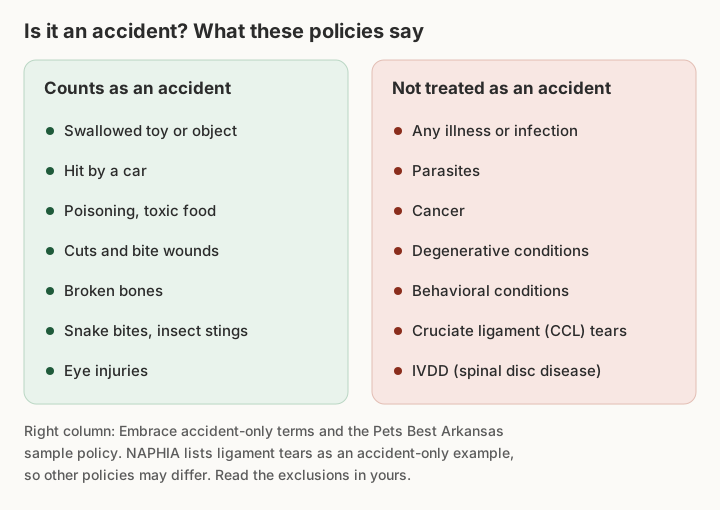 Diagram by Zero To Insurance. Simplified; the right column follows the Embrace accident-only terms and the Pets Best Arkansas sample policy. Source: Embrace, Pets Best, ASPCA, NAPHIA.
The cruciate ligament catch
The cruciate ligament is a band of tissue inside the knee. Many owners know it as the ACL. A tear is often called a CCL tear. IVDD (intervertebral disc disease) is a problem with the discs between the bones of the spine.
Here the sources disagree. NAPHIA, the industry association, lists "ligament tears" as an example of what accident-only products cover (NAPHIA). But the two accident-only policies we read both exclude it.
Embrace's accident-only terms say IVDD and cruciate ligament injury are "a degenerative process, not an Accident." They add: "Though it can show signs suddenly and seem like an Accident, it is not covered as an Accident by this policy" (Embrace policy terms). Embrace's plan page also names "orthopedic conditions like CCL tears" as not covered.
The Pets Best sample policy goes further. It says cruciate ligament events "are always considered medical Conditions, as opposed to a Condition caused by an Accident or injury." It uses the same words for disc problems (Pets Best sample policy).
So a knee injury can happen in one moment, look exactly like an accident to you, and still be refused under these accident-only plans. Under an accident and illness plan the picture changes: Pets Best lists cruciate ligament injuries as an eligible illness in its accident and illness plans (Pets Best). If knee or back trouble worries you, read the exclusions list before you choose. Our breed-by-breed dog insurance guide looks at breed-specific risks.
What accident and illness coverage adds
NAPHIA defines accident and illness plans as "accident benefits plus illnesses such as cancer, infections, digestive problems" (NAPHIA). Pets Best's list of eligible illnesses includes cancer, diabetes, arthritis, allergies, skin and ear infections, urinary tract infections, seizures, heart disease and kidney disease (Pets Best).
Pets Best notes that many illnesses "require long-term care or lifelong management." Accident-only does not cover treatment for these illnesses.
Two things stay out, even with accident and illness cover:
- Pre-existing conditions. A pre-existing condition is a health problem that started before the policy began or during the waiting period. Pets Best says these are "not eligible for coverage," but conditions that heal, such as a broken leg or kennel cough, are not considered pre-existing once healed (Pets Best). The NAIC model law uses a similar definition: a vet gave advice, the pet was treated, or the pet had signs of the problem before coverage started (NAIC).
- Routine care. Wellness exams, vaccines and flea and tick prevention are not part of Pets Best's accident and illness plans. Under the NAIC model law, a wellness program sold apart from the policy is not insurance and must be priced and described separately.
For a side-by-side look at full accident and illness plans, see our best pet insurance guide. Our pet insurance cost guide goes deeper into what drives the price. Note that both of those guides use NAPHIA's 2024 figures. This guide uses the 2025 figures NAPHIA published in June 2026.
How much cheaper is accident-only?
NAPHIA publishes the average yearly premium for U.S. pets with each plan type. These are averages for policies in force, not quotes (NAPHIA SOI 2026).
| Year | Dogs, accident-only | Dogs, accident & illness | Cats, accident-only | Cats, accident & illness |
|---|---|---|---|---|
| 2021 | $192 | $625 | $121 | $370 |
| 2022 | $201 | $640 | $122 | $387 |
| 2023 | $204 | $675 | $116 | $383 |
| 2024 | $193 | $749 | $110 | $386 |
| 2025 | $190 | $836 | $112 | $435 |
Our own math on the 2025 numbers: for dogs, accident and illness cost $646 more per year than accident-only ($836 − $190). For cats the gap was $323 ($435 − $112). Divided by 12, that is about $16 a month against about $70 for dogs, and about $9 against about $36 for cats.
The gap has also grown. Between 2021 and 2025 the accident-only average barely moved: $192 to $190 for dogs and $121 to $112 for cats. Over the same years the accident and illness average rose from $625 to $836 for dogs and from $370 to $435 for cats. For 2025 alone, NAPHIA reports a change of +11.5% (dogs) and +12.6% (cats) for accident and illness, against −1.6% (dogs) and +1.4% (cats) for accident-only.
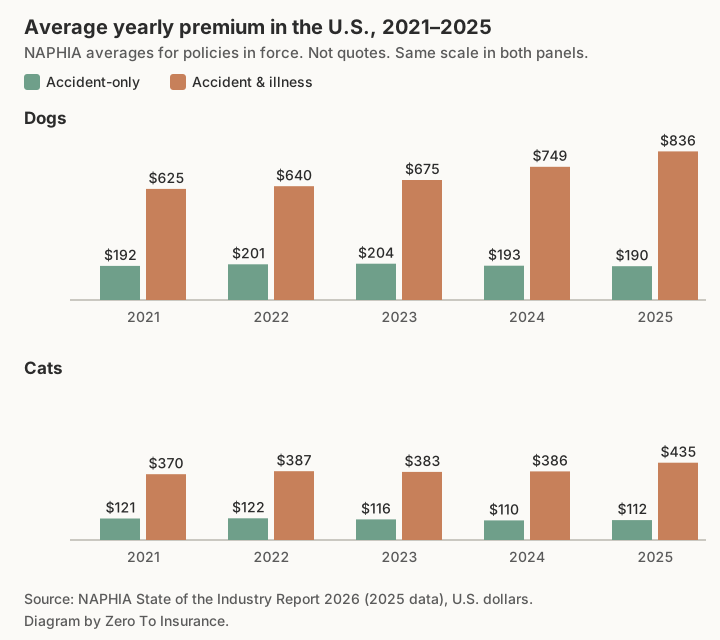 Diagram by Zero To Insurance. Simplified; averages for U.S. policies in force, not quotes. Source: NAPHIA State of the Industry Report 2026 (2025 data).
For an insurer's own starting price: Pets Best says its accident-only plans "start at just $6 per month for cats and $9 per month for dogs, regardless of your pet's age and breed," or $7 and $10 in Washington state (Pets Best, as listed October 23, 2026). A starting price is the lowest price, not what every owner pays.
Check the annual limit as well as the premium. Embrace's accident-only plan pays up to $5,000 a year, with a $100 yearly deductible and 90% reimbursement, and these terms "are not flexible" (Embrace help). The Pets Best Arkansas sample policy shows a $10,000 annual limit, a $250 deductible and 90% reimbursement (Pets Best sample policy). That is a sample form, so your state's version may differ.
Waiting periods and other fine print
A waiting period is the time after you buy a policy before some or all of the cover starts. The NAIC Pet Insurance Model Act allows insurers to set a waiting period of up to 30 days for illnesses and orthopedic conditions that are not caused by an accident. It also says: "Waiting periods for accidents are prohibited" (NAIC).
That is a model law. It is a template that each state can adopt or not. The Pets Best accident-only sample policy for Arkansas has "a three-day Waiting Period" before accident cover begins (Pets Best sample policy). Pets Best also says that "waiting periods vary by state and coverage type" (Pets Best). The only safe answer is the policy for your own state.
Other rules in Embrace's accident-only terms are worth knowing (Embrace policy terms):
- Illness after an accident. An illness caused by a covered accident is only covered if it is part of the initial course of treatment for that injury. Embrace's own example: later treatment for liver damage after a poisoning is not covered.
- Swallowed objects. Only the first removal of a swallowed object under anesthesia is covered in each policy year.
- Behavior problems from before. Treatment linked to a behavior problem your pet already had is excluded. Embrace's example is a dog that persistently ate rocks or other objects before coverage began.
- No preventive care or boarding. Vaccines, spaying or neutering and wellness exams are excluded.
The Pets Best sample policy adds two more points:
- Repeat behavior. Injuries from a repeated behavior are excluded if the same or a similar behavior happened two times within 18 months before treatment.
- Trial period. New policyholders can cancel within 30 days and get a full refund, as long as no claims have been paid.
When accident-only makes sense
Accident-only is a narrow product. In some situations it is the right fit:
- Your pet is too old for full cover. At Embrace, dogs and cats aged 15 and over can only enroll in the accident-only plan (Embrace help). Rules differ between insurers.
- Your pet already has illnesses. Plans generally exclude illnesses your pet already has as pre-existing conditions. Embrace says accident-only suits pets whose "illness-related pre-existing conditions" would make full cover "less valuable" (Embrace). Pets Best says the same about pets that cannot get illness cover (Pets Best).
- You want an emergency backstop on a small budget. Pets Best designs its accident plan for owners "on a limited budget," and ASPCA calls it a more affordable option for a tight budget.
- Your pet gets into trouble. ASPCA says accident-only can be especially useful for energetic, curious or mischievous pets (ASPCA).
When it does not make sense: if a cancer diagnosis or a long-term illness would leave you with a bill you could not pay, accident-only does not protect you from it. NAPHIA's list of the most common medical conditions in 2025 claims starts with digestive (GI) problems for both dogs and cats. Next come ear infections for dogs and dental disease for cats (NAPHIA). These are illnesses, not accidents.
Our view: for a young, healthy pet, accident-only should be a deliberate choice, not the default because it is cheap. If you pick it, treat it as cover for the rare emergency and keep savings for illness. Cat owners can compare full plans in our cat insurance guide.
Questions to ask before you buy
- Does a cruciate ligament tear or IVDD count as an accident? At Embrace and in the Pets Best sample policy, it does not.
- Is there a waiting period for accidents in my state? Ask for the number of days in writing.
- What are the annual limit, deductible and reimbursement rate? Some accident-only plans have fixed terms you cannot change.
- Are exam fees and medication included? Embrace normally includes exam fees and prescription drug coverage in accident-only policies and lets you remove them to lower the price. Prescription drug coverage is not included in all policies; check your state's terms.
- What happens if an accident leads to a later illness? Embrace limits cover to the first course of treatment.
- How often is a swallowed object covered? Embrace covers one removal under anesthesia per policy year.
- If I switch to accident and illness later, what counts as pre-existing? Any problem your pet shows signs of before the new cover starts can be excluded. Ask the insurer how a switch works.
- Have I read the sample policy for my state? Embrace, Pets Best and ASPCA all publish sample policies online. The exclusions section is the part to read first.
Frequently asked questions
Does accident-only pet insurance cover illness?
No. Accident-only plans pay for injuries from sudden events, such as a swallowed object, a car accident, poisoning or a cut. Illnesses such as cancer, infections and digestive problems are left out. For those you need an accident and illness plan.
Is accident-only pet insurance worth it?
It can be if your pet is too old for an accident and illness plan, if existing health problems would make illness cover less useful, or if you only want help with emergency injury bills on a tight budget. It is a poor fit if you could not pay a large illness bill yourself, because cancer and long-term disease are exactly what it leaves out.
Can you get pet insurance for an already sick pet?
Yes, but the problem your pet already has is usually not covered. Accident-only and accident and illness plans both generally exclude pre-existing conditions. Pets Best notes one exception: conditions that heal or are cured, such as a broken leg or kennel cough, are not considered pre-existing once they are healed. An accident-only plan can still pay for new injuries that happen after coverage starts. Embrace and Pets Best both describe it as an option for pets with existing health problems.
Does accident-only pet insurance cover a torn ACL or cruciate ligament?
Often not. The Embrace accident-only terms and the Pets Best sample policy both exclude cruciate ligament injuries, even when the injury seems sudden. NAPHIA does list ligament tears as an accident-only example, so policies differ. Read the exclusions in your policy before you buy.
Is there a waiting period for accident-only pet insurance?
It depends on your state and your policy. The NAIC model law bans waiting periods for accidents, but a model law only applies where a state adopts it. The Pets Best sample accident-only policy for Arkansas has a three-day waiting period. Check the sample policy for your state.
Sources and limits
This guide relies on nine sources: the NAIC Pet Insurance Model Act, NAPHIA's State of the Industry Report 2026, three Embrace pages, three Pets Best pages including an Arkansas sample policy, and ASPCA Pet Health Insurance's accident-only page. They are listed below. Premium figures are NAPHIA averages, not quotes. Monthly amounts are our own division of those yearly averages by 12.
We did not buy these policies or file claims. Terms vary by state and change; read the sample policy for your state before you buy.
Sources checked October 23, 2026.
Sources
- NAIC — Pet Insurance Model Act (Model #633)
- NAPHIA — State of the Industry Report 2026, Highlights (2025 data)
- Embrace — Accident-only pet insurance plan
- Embrace — Accident Only Pet Health Insurance policy terms
- Embrace — Help: What is Embrace's accident-only pet insurance plan?
- Pets Best — Accident Only pet insurance
- Pets Best — Pet insurance coverage overview
- Pets Best — Accident Only sample policy form (Arkansas, IAIC-PB10001-ACC)
- ASPCA Pet Health Insurance — Accident-only pet insurance explained
About the author
Marvin
Independent researcher writing about consumer-facing financial and insurance products. See the about page for full credentials and editorial policy.
Keep reading
guides
How Much Does Pet Insurance Cost? (2026 Breakdown)
guides
Pet Insurance for Beagles: 2026 Guide (Chronic Ears, Obesity Pipeline, Epilepsy)
reviews
Best Cat Insurance in 2026: Honest Reviews for Indoor, Outdoor, and Senior Cats
guides