guides
Exotic Pet Insurance: Who Covers Birds, Rabbits and Reptiles
A US guide to vet-bill insurance for birds, rabbits, reptiles and other exotic pets. Understand Nationwide’s plan options, price claims and exclusions, plus how discounts and liability cover differ.
Yes, US owners can get vet-bill insurance for eligible birds, rabbits, reptiles and other exotic pets through Nationwide; its 2025 employee-benefits sheet requires accident coverage and makes illness coverage optional. Nationwide says it is the only pet insurer that covers birds and exotic pets; we found no other US vet-bill insurer for exotics in our sources, but did not search the whole market. The term “exotic pet insurance” also brings up discount plans and liability insurance, which serve different needs.
This guide separates those products and explains the published options without ranking them. For the broader dog-and-cat comparison, see our best pet insurance guide.
Quick answer
| Product type | What it pays for | Example in our sources | Is it insurance? |
|---|---|---|---|
| Vet-bill insurance | Eligible veterinary expenses under the chosen coverage | Nationwide | Yes |
| Discount plan | Discounts on veterinary services under the plan’s terms | Pet Assure | No |
| Liability insurance | Injury or property damage to others, plus legal defense | Prime Insurance | Yes, for liability |
Start with the bill you want help paying. Treatment for your rabbit belongs in the first row. A discount on care belongs in the second. A claim from someone injured by your animal belongs in the third. Liability means your legal responsibility for harm to someone else or their property.
Which exotic pets can be insured
Nationwide’s 2025 employee-benefits sheet lists amphibians, birds, chameleons, chinchillas, ferrets, geckos, gerbils, guinea pigs, hamsters, iguanas, lizards, mice, rats, rabbits, snakes, tortoises and turtles. Its public page also names mini pigs and goats among its categories.
So rabbits, birds and reptiles are all within the published scope. Ferrets and other listed small mammals appear too. A listed category is a starting point for checking eligibility, rather than a promise that every animal within it qualifies.
The public page’s exclusions include:
- Venomous or poisonous species.
- Endangered or threatened species.
- Species requiring a state or federal permit, license or registration.
- Species illegal to own under state or federal law.
- Hybrids of domesticated pets and wild or non-domesticated species.
- Species kept in flocks or on display.
- Other species not listed by Nationwide.
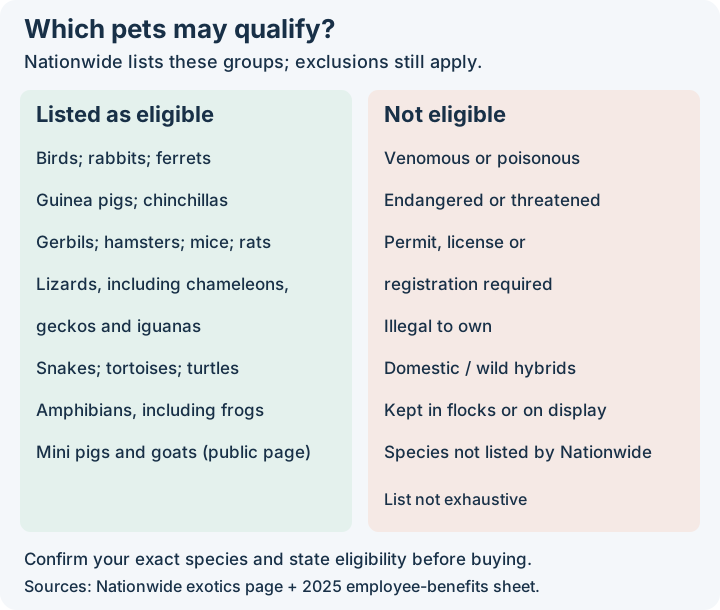 Diagram by Zero To Insurance. Listed groups still face eligibility exclusions. Sources: Nationwide public page and 2025 employee-benefits sheet.
What the Nationwide avian and exotic plan covers
The 2025 employee-benefits sheet says all plans require accident coverage. Its accident examples include broken bones, animal attacks, poisoning and heatstroke. Illness coverage is optional in the customizable plan. Additional hereditary and congenital coverage is also optional: these terms mean inherited conditions and conditions present from birth.
The public page gives examples by animal group:
| Pet group | Examples Nationwide lists |
|---|---|
| Small mammals | Overgrown teeth, eye infections, bladder infections, dehydration or constipation |
| Birds | Feather picking or loss, excessive egg-laying, soft tissue trauma, diarrhea |
| Reptiles and amphibians | Internal parasites, upper respiratory infections, soft tissue trauma, dehydration or constipation |
These examples do not override the coverage you select or the exclusions. The public page broadly describes accident and illness protection, while the sheet gives an optional illness choice. Ask which version your quote uses. Our accident-only vs accident and illness guide explains why that distinction matters.
Nationwide says you can use any licensed veterinarian, including specialists and emergency providers. Nationwide does not cover pre-existing conditions. Under the NAIC model definition, that means a condition that began before coverage or during a waiting period, including prior vet advice, treatment or related signs and symptoms, so a diagnosis is not the only possible test. Nationwide allows members to request a review of a cured condition; an exception may then be added. That is a review process, not automatic coverage.
Wellness needs a direct question at quote time. The 2025 sheet shows an optional bird wellness add-on in its customizable plan, but the public page says wellness coverage is not available for exotic pets at this time. Wellness means routine care rather than treatment of a new injury or illness. The sources differ by published plan or sales channel; ask when you get a quote whether bird wellness is actually available to you.
Plan options, deductibles and limits
The table below comes from Nationwide’s 2025 employee-benefits product sheet, not an individual quote. Plans may not be available in all states, and eligibility and individual terms can differ. The sheet says the insurance contract controls.
A deductible is the annual amount you pay toward eligible bills before reimbursement. The reimbursement rate is the share of an eligible bill the insurer pays back after the deductible. An annual limit is the most the plan pays in a policy year for the stated coverage.
| Option | Annual deductible; reimbursement | Annual accident / illness maximum | Bird wellness |
|---|---|---|---|
| Accident & Illness | $250; 80% | $5,000 accident; $5,000 illness | Not shown on the sheet |
| Accident, Illness & Wellness | $250; 80% | $5,000 accident; $5,000 illness | Not shown: the sheet leaves this row blank despite the plan name; ask at quote time |
| Customizable | $100–$500; 50%, 70% or 80% | $2,500 or $5,000 for accident; $2,500 or $5,000 for optional illness | Optional; $200, $300 or $500 annual maximum |
Source: Nationwide 2025 employee-benefits sheet. The sheet lists accident and illness limits separately. Do not treat either limit as unlimited cover or assume that all expenses qualify. Its customizable wellness amounts apply to birds; they do not establish rabbit or reptile wellness coverage.
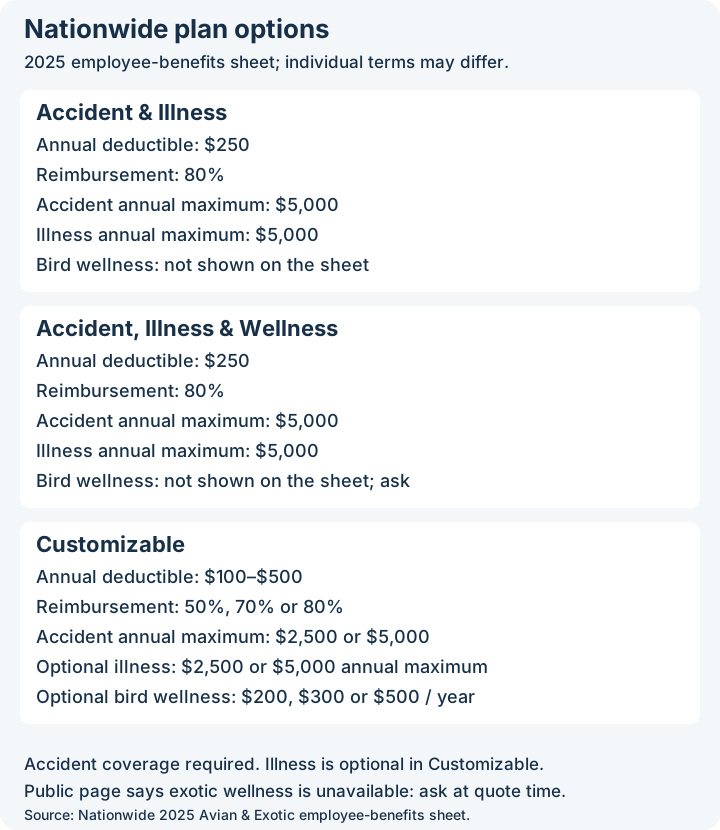 Diagram by Zero To Insurance. Published employee-benefits options, not a quote; public wellness availability differs. Source: Nationwide 2025 sheet.
How much does exotic pet insurance cost?
Nationwide says premiums generally start at less than $21 a month. The premium is the price you pay to keep the policy. Nationwide says it depends on the type of pet and the amount of coverage selected. This is a starting-price statement, not a quote for your animal or a typical monthly bill.
There is no US market average for exotics established by our sources. NAPHIA’s 2026 highlights report, using 2025 data, publishes average premiums for dogs and cats only. Those figures cannot supply an average for rabbit, bird or reptile insurance. Our broader pet insurance cost guide provides dog-and-cat context; use an exotic-pet quote for your own budget.
A rabbit claim example, with the math
Nationwide’s sheet uses Oreo, a rabbit treated for an intestinal obstruction, to show a $3,330 veterinary bill. It shows $2,156 reimbursed and $1,174 paid by the owner, with a 70% reimbursement rate and a $250 annual deductible that had not been met on earlier claims.
The calculation is:
- Subtract the deductible: $3,330 − $250 = $3,080.
- Apply the reimbursement rate: $3,080 × 0.70 = $2,156.
- Find the owner’s share: $3,330 − $2,156 = $1,174.
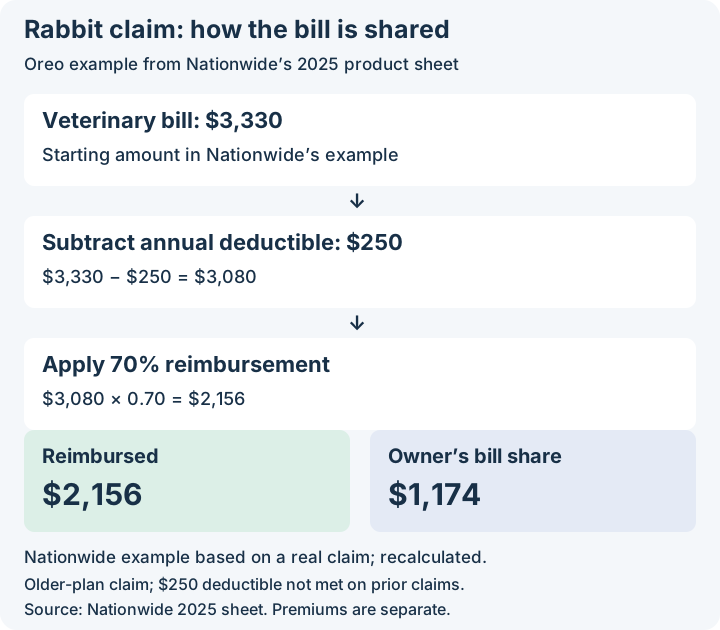 Diagram by Zero To Insurance. Nationwide example based on a real claim; recalculated. Source: 2025 product sheet.
The footnote matters: Nationwide based this illustration on a real member’s claim under an older plan, then recalculated it for the new Avian & Exotic plan. It is neither an average rabbit treatment cost nor a promise about another claim. The owner’s share shown here is part of the vet bill; policy premiums are a separate expense.
Discount plans and liability cover are different products
Pet Assure describes its offering as a Veterinary Discount Plan and a pet insurance alternative. It says its offering covers in-house medical services, including wellness exams and pre-existing conditions. Read that as Pet Assure’s description of its discount product. It does not establish an insurance reimbursement rate or an insurance payout limit.
Ask what services receive a discount and whether your vet accepts the plan. A discount may reduce a bill, but it should not be confused with a policy that reimburses an eligible claim.
The NAIC model law defines wellness programs as separate from an insurance policy and says they must not be marketed as pet insurance. This distinction does not resolve Nationwide’s conflicting wellness availability statements.
Prime Insurance’s exotic-pet page addresses liability through agents and brokers. It describes protection for third-party bodily injury or property damage and legal defense costs, subject to limits. That answers a different question from who pays to treat your own animal.
Is exotic pet insurance worth it?
Compare the premium you are quoted with the portion of an unexpected eligible bill you would still need to pay. In Nationwide’s rabbit illustration, insurance reimburses $2,156, while the owner still pays $1,174 of the bill. The example shows how cost sharing works; it cannot tell you how likely your pet is to need similar treatment.
The sheet’s $2,500 or $5,000 annual limits also restrict the payout for the relevant coverage. An illness exclusion or a pre-existing-condition exclusion can matter more than the headline percentage. Nationwide excludes pre-existing conditions, so consider the timing of enrollment before a health problem develops; earlier enrollment still does not guarantee a future claim will qualify.
Saving money in a dedicated pet-care fund is another way to prepare. Compare how much you could set aside with the bill you could afford today. Insurance and savings leave different amounts of financial responsibility with you. Our sources do not establish which will cost less for your particular animal.
Questions to ask before you buy
- Is my exact species eligible? Check the species and exclusion lists, including permit and hybrid rules.
- Is this plan available in my state? The 2025 sheet warns that availability and eligibility vary.
- Which deductible, percentage and limits apply? Have the quote identify each figure and separate accident and illness limits.
- Is illness included or optional? Confirm hereditary and congenital coverage too; do not infer it from the product name.
- Is wellness available for my animal through this quote? Point out the difference between the public page and the employee sheet, especially for birds.
- What is the waiting period in my state? A waiting period is the time before some coverage begins. The NAIC model law allows at most 30 days for illness or non-accident orthopedic conditions, which affect bones and joints, and prohibits accident waiting periods. These rules apply only where a state has adopted them; they are not a nationwide promise.
- What counts as pre-existing, and how does a cured-condition review work? Ask for the Nationwide policy wording and the review requirements.
- Am I buying insurance or a discount plan? Read the Pet Assure description before comparing prices.
Outside the US
In the UK, ExoticDirect offers specialist pet insurance for reptiles, birds and small mammals. This guide concerns US options; the UK offering does not establish US eligibility or policy terms.
Frequently asked questions
These answers use Nationwide’s eligibility and price statements, NAPHIA’s dog-and-cat report and Pet Assure’s product description.
Can you get insurance for a rabbit?
Yes. Nationwide lists rabbits as eligible for its avian and exotic vet-bill insurance. Check your rabbit’s eligibility, the illness option and the policy terms for your state before buying.
Does any company insure birds?
Nationwide offers vet-bill insurance for birds. It says it is the only pet insurer that covers birds and exotic pets. We found no other US vet-bill insurer for exotics in our sources, but did not search the whole market.
What is the average cost of exotic pet insurance?
Our sources do not establish a US market average for exotic pets. NAPHIA’s 2026 report gives dog and cat premium figures only. Nationwide says premiums generally start at less than $21 a month; that is a starting-price statement, not an average.
Is Pet Assure pet insurance?
No. Pet Assure describes its product as a Veterinary Discount Plan and a pet insurance alternative. Compare its discount terms with an insurance policy rather than assuming they pay bills in the same way.
Can you get pet insurance for reptiles?
Yes. Nationwide lists lizards, snakes, tortoises and turtles, among other animals. Its eligibility exclusions still apply, including venomous or poisonous species and species that require a permit, license or registration.
Sources and limits
The linked public pages, product sheet, industry report and model law support the claims above. Nationwide’s older announcement is historical context only; we use the 2025 sheet for plan parameters. The sheet is an employee-benefits version, so obtain the documents for the individual policy you are offered.
We did not buy a policy or file a claim. Plans, prices and eligibility vary by state and change; check the policy documents before you buy.
Sources checked October 25, 2026.
Sources
- S1 — Nationwide: Exotic pet insurance
- S2 — Nationwide: 2025 Avian & Exotic employee-benefits product sheet
- S3 — Nationwide: Historical avian and exotic plan announcement
- S4 — Pet Assure: Exotic pets
- S5 — Prime Insurance: Exotic pets liability
- S6 — NAPHIA: State of the Industry 2026 Highlights
- S7 — NAIC: Pet Insurance Model Act #633
- S8 — ExoticDirect: UK exotic pet insurance
About the author
Marvin
Independent researcher writing about consumer-facing financial and insurance products. See the about page for full credentials and editorial policy.
Keep reading
guides
Accident-Only vs Accident and Illness Pet Insurance: What Each Covers
guides
Pet Insurance for Beagles: 2026 Guide (Chronic Ears, Obesity Pipeline, Epilepsy)
reviews
Best Cat Insurance in 2026: Honest Reviews for Indoor, Outdoor, and Senior Cats
guides