guides
Pet Insurance and Pre-Existing Conditions: What Gets Covered and When
What counts as a pre-existing condition in pet insurance, how insurers treat curable and incurable conditions, and how long each one says you have to wait. Based on the NAIC model law and the insurers' own published rules.
Most pet insurance does not cover pre-existing conditions. A pre-existing condition is a health problem your pet had signs of, was treated for, or got vet advice about before the policy started or during the waiting period. Some insurers split these problems into curable and incurable ones. A curable condition, such as a bladder infection, may be covered again after a set time without symptoms or treatment. An incurable one, such as diabetes, usually stays excluded. New problems that are not related to the old one can still be covered.
This guide puts the published rules of six insurers side by side: Embrace, Healthy Paws, Figo, Nationwide, Pets Best and AKC Pet Insurance. It starts from the model definition written by the National Association of Insurance Commissioners (NAIC). We use these insurers as examples, not as recommendations. For a wider comparison of plans, see our best pet insurance guide.
This guide has no affiliate links. Every rule below links to the insurer's own page or policy. If you spot an error, email us and we will publish a correction.
Quick answer: which insurers may cover a cured condition
| Insurer | Curable conditions | Chronic/incurable | How it's checked |
|---|---|---|---|
| Embrace | May be covered after 12 consecutive months symptom- and treatment-free | Permanently excluded | Vet records from the 12 months before the policy; free Medical History Review on request |
| Healthy Paws | May be eligible after 365 continuous days symptom- and treatment-free | Not stated in source | Not stated in source |
| Figo | May be covered if no signs or symptoms within 12 months of treatment | Not stated in source | Not stated in source |
| Nationwide | Members can ask for a review; 2022 form: cured and treatment-free for 6 to 12 months, depending on the condition | Not eligible (2022 form) | Review request with complete vet records from the past 12 months |
| Pets Best | No exception mentioned in FAQ | Not covered; may offer accident-only for severe chronic conditions | Not stated in source |
| AKC Pet Insurance | Covered after 365 days of continuous coverage (company claim, not in all states) | Covered after 365 days of continuous coverage (company claim, not in all states) | Not stated in source |
Sources: Embrace help, Embrace FAQ, Healthy Paws, Figo, Nationwide FAQ, Nationwide review form, Pets Best FAQ, AKC Pet Insurance. "Not stated in source" means the page we checked does not say. It does not mean the insurer has no rule.
Two things stand out. First, most of these rules use the word "may". A waiting time does not guarantee cover; the insurer still decides. Second, AKC Pet Insurance counts something different. Its 365 days are days of continuous coverage, not days without symptoms.
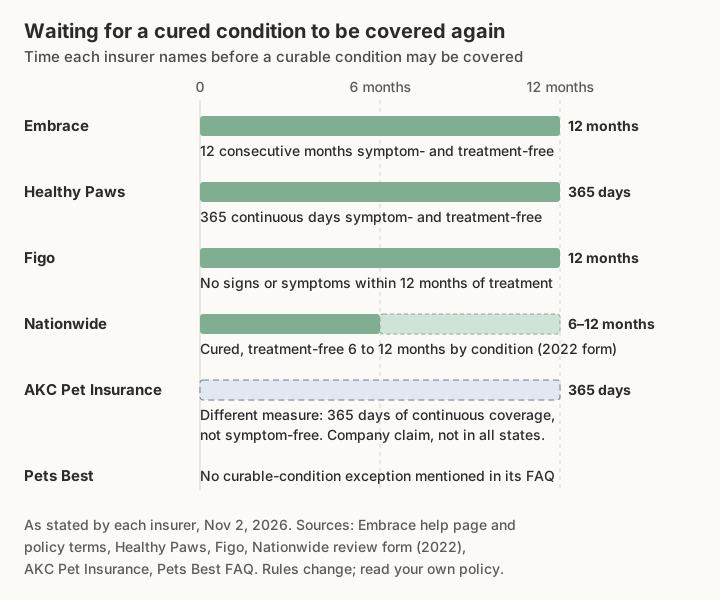 Diagram by Zero To Insurance. Simplified; as stated by each insurer, Nov 2, 2026. AKC's period is continuous coverage, not a symptom-free period. Source: Embrace help page and policy terms, Healthy Paws, Figo, Nationwide review form (2022), AKC Pet Insurance, Pets Best FAQ.
What counts as a pre-existing condition
The NAIC Pet Insurance Model Act gives a three-part test. A condition is pre-existing if any of these were true before the policy's start date or during any waiting period (NAIC):
- A veterinarian provided medical advice.
- The pet received previous treatment.
- Based on information from verifiable sources, the pet had signs or symptoms directly related to the condition for which a claim is being made.
A waiting period is the time after you buy a policy before some or all of the cover starts. Under the model act, a problem that first shows up in that window counts as pre-existing too. Embrace's illness waiting period is 14 days, and its policy says conditions that occur during it "will be excluded from your policy's Coverage as Pre-existing Conditions" (Embrace policy terms).
You do not need a diagnosis for a problem to count. Healthy Paws says "there doesn't need to be a diagnosis" (Healthy Paws). Pets Best says a condition counts "even if it wasn't formally diagnosed by a veterinarian" (Pets Best).
Nationwide gives two examples on its own page (Nationwide):
- Teeth. A vet says your pet needs a thorough dental cleaning, and the records show it. Dental tartar and periodontitis are then pre-existing.
- A limp. Your pet limps before the policy starts, but nobody finds the cause. One to two months into the policy, a vet finds hip dysplasia. Nationwide treats the hip dysplasia as pre-existing, because the limp came first.
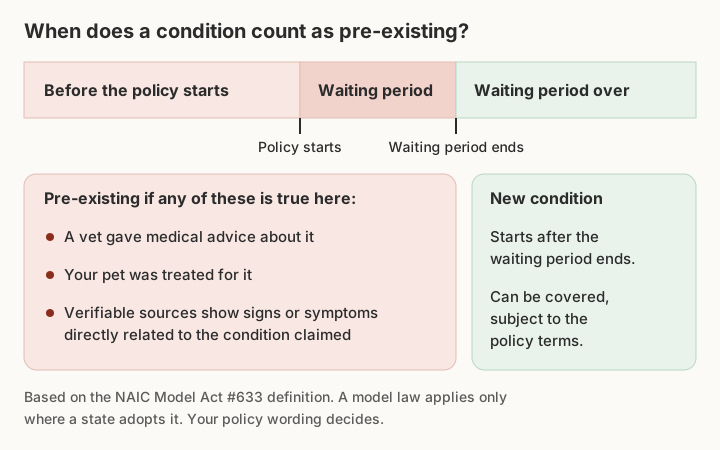 Diagram by Zero To Insurance. Simplified; your policy wording decides. Source: based on NAIC Model Act #633 definition.
The NAIC act is a model law. That is a template that each state can adopt or ignore. It only has force in states that adopt it, so the definition in your own policy is the one that counts. Embrace's policy terms and Nationwide's page use the same three-part wording.
Curable vs incurable conditions
Some insurers split pre-existing conditions into two groups.
A curable condition is one that goes away. Embrace calls these "temporary" conditions (Embrace help). Its policy defines a Temporary Condition as "an abnormal Clinical Sign or diagnosis, which is likely to resolve" (Embrace policy terms).
An incurable or chronic condition is one that can be managed but not cured. Embrace's policy defines a Chronic Condition as one "that can be treated or managed, but not cured." Its help page adds conditions that keep coming back.
Embrace gives these examples on its help page and coverage FAQ (Embrace FAQ):
- Curable: respiratory infections, urinary tract or bladder infections, vomiting, diarrhea and other gastrointestinal disorders, ear infections, and undiagnosed vomiting or diarrhea.
- Incurable: diabetes, arthritis and allergies.
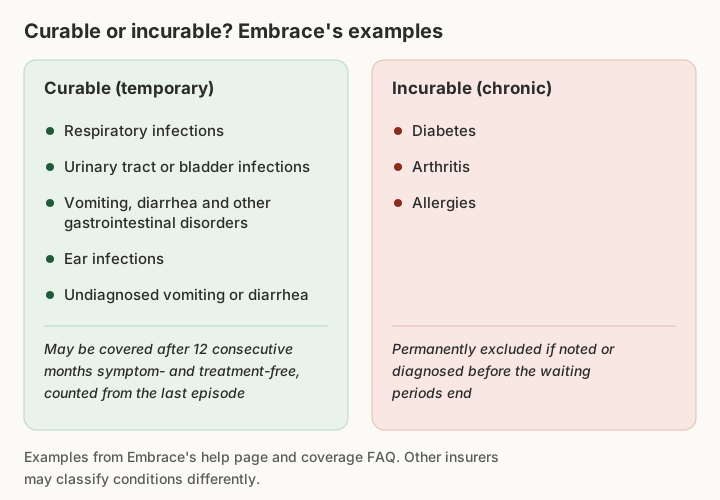 Diagram by Zero To Insurance. Simplified; examples from Embrace, other insurers may classify differently. Source: Embrace help page and coverage FAQ.
Three details from Embrace's policy terms matter here:
- A temporary problem can turn chronic. The policy says "A Temporary Condition may become a Chronic Condition." So a problem that looks curable at first may later be treated as incurable.
- Skin problems count as one group. The policy files ear infections under skin conditions. If your pet showed signs of any skin condition before the waiting period ended, it must be free of all skin conditions for 12 consecutive months before any of them may be covered again.
- Vomiting and diarrhea count as one group. If your pet was treated for undiagnosed vomiting or diarrhea before the waiting period ended, it must be free of conditions with the same signs for 12 consecutive months.
Example (made up for illustration). Your dog has an ear infection in March. The vet treats it and it clears up. You buy an Embrace policy in May. Under Embrace's rules, the ear infection is a curable pre-existing condition. Because Embrace files ear infections under skin conditions, a new ear or skin problem in the 12 months after the last episode would not be covered. If nothing comes back, skin and ear problems may be covered after those 12 months (Embrace help, Embrace policy terms). A new, unrelated problem, like a cut paw, is not affected by the ear history.
How long until a cured condition can be covered
Each insurer names its own waiting time. Here is what each one says, in its own terms.
- Embrace. A curable condition is "eligible for coverage once your pet is symptom- and treatment-free for 12 consecutive months from the date of the last episode." Incurable conditions are "permanently excluded from coverage" if they were noted or diagnosed before the end of the waiting periods (Embrace help). The policy terms set the same 12 consecutive months (Embrace policy terms).
- Healthy Paws. Curable conditions "that fully resolve and remain symptom- and treatment-free for a continuous period of 365 days may be eligible for coverage" (Healthy Paws).
- Figo. "We may cover pre-existing conditions considered curable if they show no signs or symptoms within 12 months of treatment" (Figo).
- Nationwide. Nationwide's FAQ says members can ask for a review of a pre-existing condition that has been cured, "in which case an exception may be added" (Nationwide FAQ). Nationwide's 2022 review form says the condition must have been "deemed cured and remained treatment-free for a period of 6 to 12 months based upon the condition being reviewed." Chronic conditions and others that cannot be cured "are not eligible for coverage" (Nationwide review form).
- Pets Best. Pets Best's FAQ does not mention a curable-condition exception. It says that if your pet was diagnosed before the policy started, "you can still enroll, but there wouldn't be coverage available for these specific issues or issues related to them" (Pets Best).
- AKC Pet Insurance. AKC Pet Insurance says it covers "curable and incurable pre-existing conditions" after "365 days of continuous coverage." It adds that this is "not available in all states" (AKC Pet Insurance). The page also calls AKC the "ONLY brand" with this cover, based on its own comparison with five other insurers. That is the company's marketing claim, and we have not checked it.
This clashes with what other insurers write. Embrace says "No pet insurance company covers pre-existing conditions." Pets Best says "All pet insurance providers, including Pets Best, do not cover pre-existing conditions." These are claims by those companies, not market studies, and AKC Pet Insurance claims the opposite for its own plans.
Knees, hips and both sides of the body
A bilateral condition is one that can affect both sides of the body. Embrace gives hip dysplasia and cruciate ligament tears as examples (Embrace FAQ). The cruciate ligament is a band of tissue inside the knee, often called the ACL. Some insurers exclude the second side once the first side is pre-existing, because the risk on the other side is higher.
Healthy Paws says pre-existing cruciate ligament injuries are not covered. If the cruciate ligament on one leg is injured before enrollment or during the 15-day waiting period, the ligament on the other leg is excluded too. Healthy Paws calls this "the only bilateral exclusion in our policy." Cruciate ligament treatment is covered when it is not pre-existing (Healthy Paws).
Embrace has a longer window for dogs. Its policy names four orthopedic conditions: cruciate ligament disease, intervertebral disk disease (IVDD, a spine disc problem), patellar luxation (a kneecap that slips out of place) and hip dysplasia. If one of these shows signs in the first 180 days after the policy starts, it is pre-existing "for the life of the policy" (Embrace policy terms). The same 180 days apply to bilateral conditions. A dog with cruciate ligament disease in the left leg during that time will not be covered for a later problem in the right leg. For IVDD, signs before the policy or in the first 180 days mean no cover for future IVDD "in any area" of the spine.
There is also good news in Embrace's FAQ. If a bilateral condition on one side is covered, Embrace says it "will also cover the condition if it occurs on the other side."
AKC Pet Insurance's page marks cruciate ligament illness with a note: "After 180 days of continuous coverage" (AKC Pet Insurance). For breed-linked knee, hip and back conditions, see our dog insurance by breed guide.
How insurers find out about past conditions
Insurers check your pet's vet records. When they do it differs.
Embrace says it defines pre-existing conditions by asking for your pet's medical records from the 12 months before the policy was bought, or less for a new pet (Embrace FAQ). Its policy says it will not review that history until your first illness claim, unless you ask for a Medical History Review. That is a check by a claims adjuster who tells you which conditions, if any, would count as pre-existing. Embrace says the review is free, is only done on request, and can be asked for any time after the 14-day illness waiting period (Embrace policy terms). If you don't like the result, Embrace says you can cancel and get a pro-rated refund of the unused premium.
Embrace also requires a vet exam in the 12 months before the policy starts or within 14 days after. Without one, the policy switches to accident-only cover. You can add illness cover back once a qualifying vet has examined your pet and Embrace has the detailed records of that exam. Pre-existing conditions may then be set based on that exam. You must also list every vet your pet has seen in that time. Leaving one out counts as concealment under the policy.
Nationwide reviews a cured condition only when you send in its review form (Nationwide review form). The form asks for complete medical records from every vet your pet saw in the 12 months before the request. Invoices and vaccine certificates do not replace those records. The form recommends sending the request when you file a claim and says processing "can take up to several weeks."
The NAIC model act adds two rules on the insurer's side (NAIC). If a vet exam is needed to start cover, the insurer must say before purchase that the exam records "may result in a preexisting condition exclusion." And "the pet insurer has the burden of proving" that the exclusion applies to the condition in a claim. In plain words: under the model act, it is up to the insurer to show the condition was pre-existing, not up to you to show it wasn't. Again, this only applies in states that have adopted the model act.
What you can do if your pet already has a condition
The honest answer: an existing problem is very unlikely to be covered soon. But insurance can still be useful.
- You can still enroll. Embrace says it "can cover new or unrelated conditions" for pets with pre-existing conditions (Embrace help). Pets Best says cover "will cover most future accidents and illnesses should something happen" (Pets Best).
- Ask for a medical history review where it is offered. At Embrace you can learn what counts as pre-existing before you file a claim (Embrace FAQ).
- Look at accident-only cover. Pets Best says it offers "accident only coverage for pets with severe chronic conditions" (Pets Best). Our guide to accident-only vs accident and illness pet insurance explains what these plans leave out.
- Track the clock for curable conditions. Write down the date of the last symptom and the last treatment. For the curable-condition exceptions, count from the date your insurer names: the last episode, the last symptoms or the last treatment. AKC Pet Insurance's stated 365 days count continuous coverage instead.
- Enroll early and avoid gaps. AKC Pet Insurance gives this tip: enroll as soon as you can, because younger pets are less likely to have a pre-existing condition, and avoid gaps in coverage (AKC Pet Insurance).
- Keep copies of vet records. Embrace asks for the vet's chart notes, and Nationwide says invoices do not replace full records.
If you have a new kitten or cat, our cat insurance guide compares plans. For what cover costs, see our pet insurance cost guide.
Questions to ask before you buy
- How does the policy define a pre-existing condition? Look for the three NAIC triggers: vet advice, treatment, or signs and symptoms.
- Do you treat curable and incurable conditions differently? If yes, ask how long a cured condition must stay clear, and whether that time counts from the last symptom or the last treatment.
- How far back do you read the vet records? Embrace asks for 12 months.
- Do you have bilateral exclusions? Ask which conditions, and whether the rule covers the knee only or other joints too.
- Is there a special window for orthopedic conditions? Embrace uses 180 days for four dog conditions. Healthy Paws ties its cruciate ligament rule to its 15-day waiting period.
- Can I get a review before I file a claim? Embrace offers one on request; Nationwide reviews cured conditions on request.
- What happens if I switch insurers? The NAIC act says a covered condition cannot become pre-existing on a renewal. But it defines renewal as a new policy from "the same pet insurer or affiliated pet insurer" (NAIC). A policy from a new insurer is not a renewal under that definition, so a condition your old insurer paid for may count as pre-existing again. Raising cover with the same insurer can also reset the clock: Embrace says an upgrade means re-underwriting, and anything that started before the upgrade date counts as pre-existing (Embrace FAQ).
- Have I read the sample policy for my state? Rules differ by state. The exclusions section is the part to read first.
Frequently asked questions
Does any pet insurance cover pre-existing conditions?
Mostly no. Embrace and Pets Best both say no pet insurance company covers them. Some insurers, including Embrace, Healthy Paws, Figo and Nationwide, say a cured condition may be covered again after a set period without symptoms or treatment. AKC Pet Insurance says it covers curable and incurable pre-existing conditions after 365 days of continuous coverage. That is the company's own claim, and the cover is not available in all states.
What is a pre-existing condition in pet insurance?
Under the NAIC model law, it is a condition where, before the policy started or during a waiting period, a vet gave medical advice, your pet was treated, or verifiable sources show your pet had signs or symptoms related to it. Embrace and Nationwide use this wording. Healthy Paws and Pets Best say a formal diagnosis is not needed.
Can I get pet insurance for a dog with a pre-existing condition?
Yes. Embrace and Pets Best both say you can still enroll. The existing condition is not covered, and Pets Best adds that issues related to it are not covered either. New and unrelated conditions can still be covered. Pets Best says it may offer an accident-only plan for pets with severe chronic conditions.
Are allergies a pre-existing condition?
They are if your pet showed signs of them before the policy started or during the waiting period. Embrace lists allergies as an incurable condition, which it permanently excludes in that case. AKC Pet Insurance lists allergies among the pre-existing conditions it says it covers after 365 days of continuous coverage, in the states where that cover is offered.
Can a pre-existing condition be covered later?
Sometimes, if it was curable. Embrace names 12 consecutive months without symptoms or treatment. Healthy Paws names 365 continuous days. Figo names 12 months without signs or symptoms after treatment. Nationwide's 2022 review form names 6 to 12 months without treatment, depending on the condition. Chronic conditions stay excluded at Embrace and, per that form, at Nationwide. The insurer makes the final decision.
Sources and limits
This guide relies on eleven sources: the NAIC Pet Insurance Model Act, three Embrace pages including its policy terms, three Nationwide pages including its 2022 review form, and one page each from Healthy Paws, Figo, Pets Best and AKC Pet Insurance. They are listed below. The Nationwide review form dates from 2022, so its terms may have changed. AKC Pet Insurance's statements are its own marketing claims.
We did not buy these policies or file claims. Rules vary by state and change; read the sample policy for your state and ask for a medical history review where the insurer offers one.
Sources checked November 2, 2026.
Sources
- NAIC — Pet Insurance Model Act (Model #633)
- Embrace — Help: What are pre-existing conditions, and does Embrace cover them?
- Embrace — Coverage FAQ
- Embrace — Pet Health Insurance policy terms (V6)
- Nationwide — Pre-existing conditions
- Nationwide — Pet insurance FAQ
- Nationwide — Review Request form (2022)
- Healthy Paws — Coverage & exclusions
- Figo — Dog insurance
- Pets Best — FAQ
- AKC Pet Insurance — Pre-existing conditions
About the author
Marvin
Independent researcher writing about consumer-facing financial and insurance products. See the about page for full credentials and editorial policy.
Keep reading
guides
Accident-Only vs Accident and Illness Pet Insurance: What Each Covers
guides
Pet Insurance for Beagles: 2026 Guide (Chronic Ears, Obesity Pipeline, Epilepsy)
guides
Best Dog Insurance by Breed 2026: Real Costs + Which Provider Suits Which Breed
reviews